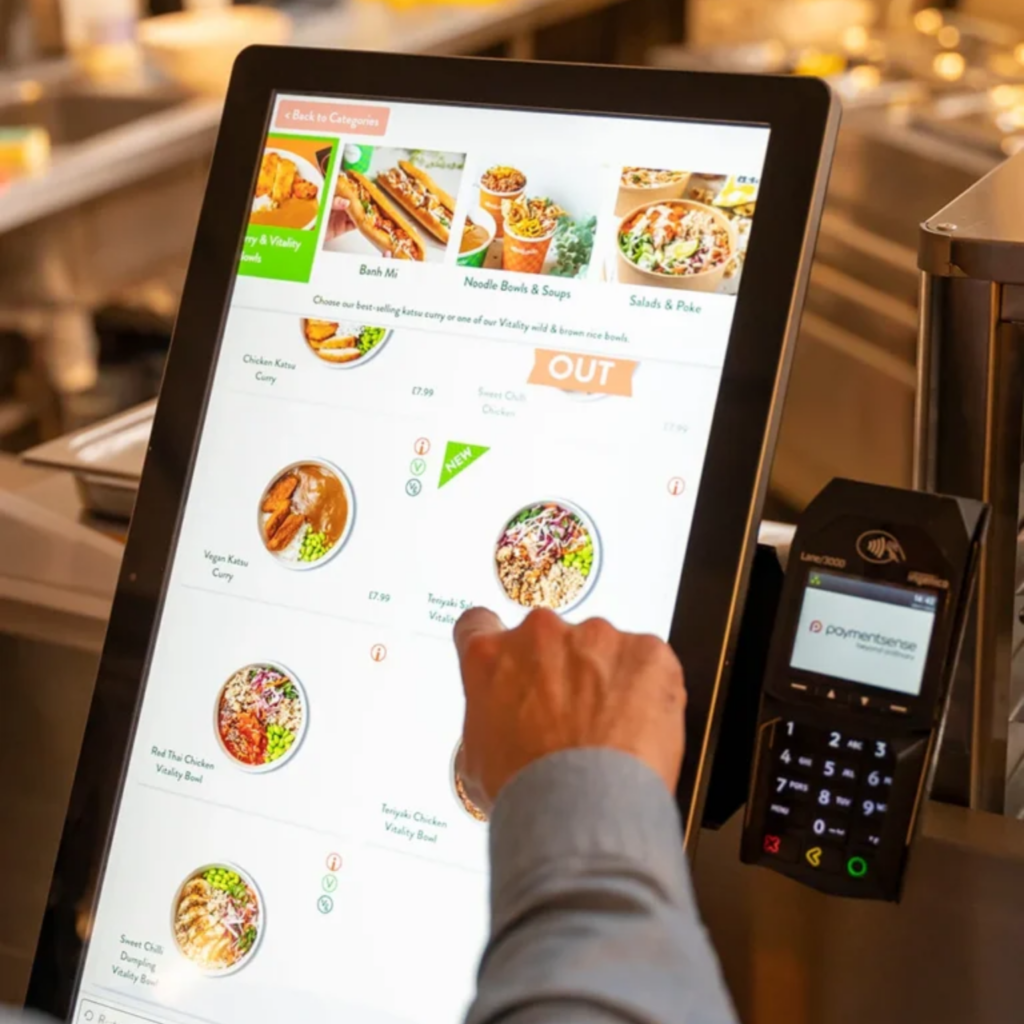
Self-Service Kiosks Are No Longer Just a Trend
Kiosks don’t just improve ordering convenience. They deliver measurable operational and commercial benefits that directly impact revenue, efficiency, and scalability.
As labour pressures increase and customer expectations continue to evolve, more QSR brands are investing in self-service technology to improve both the guest experience and business performance.
The real question is no longer “Should we introduce kiosks?”
It’s “What is outdated service technology costing us by not having them?”
Increasing Average Transaction Value (ATV)
One of the biggest commercial advantages of self-service kiosks is their ability to consistently increase average transaction value.
Unlike traditional ordering environments, kiosks automatically present:
- Upsell prompts
- Add-ons
- Meal upgrades
- Promotional bundles
- Extras and modifiers
There’s no missed upsell opportunity due to busy staff, queue pressure, or inconsistent training.
Customers also tend to browse more comfortably when ordering through kiosks, leading to:
- Larger basket sizes
- Higher add-on purchases
- Increased product discovery
Many QSR operators report significant ATV increases after implementing self-service ordering technology.
Reducing Queue Times
Queues remain one of the biggest friction points in fast-paced QSR environments.
Long waits don’t just frustrate customers, they can directly impact revenue through abandoned orders and reduced throughput.
Self-service kiosks help reduce pressure on front counter service by allowing multiple customers to order simultaneously.
This creates:
- Faster ordering experiences
- Shorter queues
- Improved customer flow
- Reduced congestion during peak periods
For busy QSR environments, improving speed of service can have a major impact on daily transaction volumes.
Faster Throughput
In many QSR environments, physical counter space creates operational limitations.
Adding more tills often means:
- More labour
- More equipment
- More floor space
- Higher operational costs
Kiosks allow operators to increase ordering capacity without significantly expanding front counter infrastructure.
This means venues can process more orders during busy periods while maintaining a smoother customer experience.
For high-footfall sites, throughput improvements alone can create substantial operational value.
Labour Optimisation, Not Labour Replacement
One of the biggest misconceptions around kiosks is that they are simply designed to reduce headcount.
In reality, most successful QSR operators use self-service technology to optimise labour allocation.
Instead of focusing staff purely on transactional ordering, teams can spend more time:
- Preparing orders
- Managing guest experiences
- Supporting customers
- Improving speed of service
- Maintaining operational flow
Kiosks help reduce repetitive front-counter pressure while allowing operators to use labour more efficiently across the business.
This becomes increasingly valuable during recruitment challenges and peak trading periods.
Improved Order Accuracy
Order accuracy is critical in QSR operations.
Mistakes can lead to:
- Slower service
- Remakes
- Increased waste
- Customer dissatisfaction
- Reduced profitability
Self-service ordering reduces communication errors by allowing customers to:
- Select products directly
- Customise orders clearly
- Review purchases before payment
This creates cleaner order flow into kitchen operations and helps reduce costly mistakes during busy service periods.
Scalability Across Multiple Sites
As QSR brands grow, consistency becomes increasingly important.
Self-service kiosks help operators standardise:
- Ordering journeys
- Promotions
- Menu presentation
- Upselling strategies
- Branding
- Customer experiences
When connected to a wider hospitality technology platform, operators can manage kiosks centrally across multiple locations while maintaining operational consistency.
This makes kiosks particularly valuable for:
- Multi-site QSR brands
- Franchise operations
- Growing hospitality groups
Customer Adoption Has Accelerated Rapidly
Customer behaviour has changed significantly over the last few years.
Today’s consumers are increasingly comfortable with:
- Digital ordering
- Contactless payments
- Self-service experiences
- Mobile-first interactions
Many customers now actively prefer kiosks because they offer:
- Faster ordering
- More control
- Reduced pressure
- Easier customisation
- Shorter perceived wait times
Self-service is no longer viewed as a novelty.
For many QSR customers, it has become an expectation.
The ROI Goes Beyond Labour Savings
The real return on investment from self-service kiosks comes from the combination of:
- Higher average transaction value
- Faster throughput
- Reduced queue pressure
- Improved operational efficiency
- Better order accuracy
- Scalable growth opportunities
- Enhanced customer experiences
When implemented correctly, kiosks become far more than an ordering tool.
They become a revenue-driving operational asset.
Looking to Introduce Self-Service Kiosks Into Your QSR Operation?
Kurve provides self-service kiosk technology designed specifically for fast-paced hospitality environments.
Integrated with EPOS, kitchen management, mobile ordering, handheld POS, loyalty platforms, and real-time reporting, Kurve helps QSR operators streamline service, improve efficiency, and grow revenue through connected hospitality technology.